Adecco's own website says, "Adecco works for everyone." That may be true for job seekers and employers. But the ATO's tax transparency data raises another question.
Did Adecco work for Australian taxpayers?
This is not a claim that Adecco broke the law. This is a public-interest story based on official ATO data. And the pattern deserves scrutiny.
The Pattern in the Data
The ATO-published tax transparency data for Adecco Holdings Pty Ltd shows a long run of large Australian income. From 2013-14 to 2021-22, Adecco Holdings reported more than $5.1 billion in total income.
Nine years: 2013-14 to 2021-22
Then the numbers changed. Because ATO corporate tax transparency data is released well after the tax year ends, the public cannot see in real time what happened next. But once the later data became public, the pattern was clear: after years of nil taxable income and nil tax payable, taxable income appeared, and company tax became payable.
2022-23
2023-24
Across the full 11-year record shown in the research grid, Adecco Holdings reported about $6.61 billion in total income and $18.13 million in tax payable. That works out to about 27 cents of company tax per $100 of total income.
What Changed?
That is the question. What changed inside Adecco's Australian tax position?
- Was there a major restructure?
- Was there a change in business model?
- Did a new contract change the numbers?
- Did the ATO review the earlier years?
- Or did public scrutiny make a long-running pattern harder to ignore?
These are fair questions. They are also the type of questions that should not need a media segment or a public campaign before they are asked.
Public scrutiny may not explain the first year that tax appeared. The reporting lag makes that hard to assess from public data alone. But the wider question remains: why did Adecco's tax position change after nine years of nil taxable income, and did the ATO review the earlier years once that change became visible?
The a Current Affair Moment
Adecco was one of the companies highlighted through national media attention in an A Current Affair story with Steve Marshall on Channel 9.
That public attention matters. Not because it proves wrongdoing. It matters because it shows what happens when official tax data is made visible.
This Was Not Just Any Company
Adecco was not a small private operator in the background. Adecco Australia Pty Ltd appears on the Australian Government's Department of Finance supplier profile.
That profile describes Adecco as a global leader in HR services, with more than 35 years in the Australian market. It also refers to Adecco's dedicated government division.
That matters because the ATO data is not just about a company operating in the private market. It raises a bigger question about government suppliers. If a corporate group reports large Australian income and no taxable income for years, should related entities keep receiving government work without closer tax review?
The ATO Connection
A Senate Estimates answer listed Adecco Australia Pty Ltd among labour hire suppliers used by the ATO. It listed 78 AusTender contract notices for Adecco Australia Pty Ltd, with a total value of about $10.6 million.
A separate parliamentary submission also stated that Adecco Australia Pty Ltd was directly controlled by Adecco Holdings Pty Ltd, the holding company for Adecco's Australian operations.
That distinction matters. The tax data is for Adecco Holdings Pty Ltd. The government supplier profile and ATO contract references are for Adecco Australia Pty Ltd. But if Adecco Australia sits within the Adecco Holdings group, the public question is clear.
The Defence Contract Makes the Question Bigger
Adecco Australia was also appointed to deliver Australian Defence Force recruiting services. The Defence announcement said the transition handover began on 1 November 2022. The new contract officially commenced on 1 July 2023.
AusTender lists the Defence recruiting contract with a current value of about $1.418 billion, running to 30 June 2029.
Winning a government contract is not wrong. But major government suppliers should meet a higher public standard. When a company group is trusted with public work, taxpayers deserve to know whether that group is also making a fair tax contribution.
The ATO's Own Message
Source: Australian Taxation Office, “Foreign residents doing business in Australia”, ato.gov.au, accessed 28 June 2026.
The ATO tells foreign residents doing business in Australia that they may need to register in Australia's tax system and pay taxes in Australia. That is a basic principle.
If a business earns income here, uses our workforce, serves our market, and benefits from our public systems, the public expects that business to pay the tax it properly owes. That is the social contract.
The Audit Question
The Adecco data changed. After years of no taxable income and no company tax payable, taxable income appeared. Then tax payable increased. That change should have triggered questions.
The ATO should ask what changed. If the later years show taxable income, then the earlier years deserve review as far back as the law allows.
The Wider System Problem
Adecco is one example. The wider issue is much larger. Hundreds of companies appear in the ATO data with large income, little or no taxable income, and little or no tax payable.
Some may have valid reasons. Some may have losses. Some may have timing issues. Some may have lawful deductions. But repeated patterns should not be waved through without scrutiny.
If a normal Australian-owned business makes no profit for years, it struggles to survive. If a small business owner keeps reporting losses, banks, suppliers, staff, and the ATO ask questions. So why does the system appear more patient when large corporate groups report the same outcome?
The Question Australians Should Ask
If a company claims it makes no taxable income here, why does it stay? There are only a few broad possibilities. One is that the business is making money, but accounting arrangements move much of the benefit elsewhere. Another is that the business is using its size, revenue, and backing to grow market share, weaken local competitors, and build power over time.
Either way, Australians deserve transparency. Australia should not be treated like a cash cow.
Stop Chasing the Easy Targets First
Governments keep looking for more money. They look at households. They look at small business. They look at PAYG workers. They look at self-funded retirees. They look at capital gains tax. They look at negative gearing.
But before government asks ordinary Australians for more, it should deal with the money already visible in its own data. The ATO has the data. Treasury has the policy power. Government has the authority. The bureaucracy has the machinery.
The public has a right to ask why this has been allowed to continue.
What Should Happen Now?
Adecco's record should be reviewed. Not through a media stunt. Through proper tax administration. The ATO should test what changed in 2022-23 and 2023-24. It should ask whether the same facts should have changed earlier years. And it should apply that same standard to other large companies with repeated nil-tax records.
Government suppliers should face even higher scrutiny. If a company wants major public contracts, it should expect strong tax transparency. That should not be controversial. It should be basic.
Questions Australians Should Be Asking
- What changed in Adecco's tax position after years of nil taxable income?
- Did the ATO review the earlier nil-tax years?
- Should major government suppliers face stronger tax checks?
- Why are companies with repeated nil-tax outcomes still treated as normal government suppliers?
- How many other large companies show the same pattern?
- Why does government keep asking ordinary Australians for more before it chases what is already visible in its own data?
View the Supporting Data
This story is based on ATO-published corporate tax transparency data. The data does not, by itself, prove wrongdoing. It does raise fair questions about tax outcomes, public contracts, enforcement, and whether Australia is collecting the company tax it should be collecting.
- ATO-published corporate tax transparency data for Adecco Holdings Pty Ltd.
- Adecco Australia website screenshot, accessed 28 June 2026.
- Australian Taxation Office, "Foreign residents doing business in Australia", accessed 28 June 2026.
- Department of Finance supplier profile for Adecco Australia Pty Ltd.
- Senate Estimates answer on ATO labour hire and outsourcing.
- Defence media release announcing Adecco Australia's ADF recruiting role.
- AusTender Contract Notice CN3923195.
- Senate Select Committee submission discussing Adecco Holdings Pty Ltd and Adecco Australia Pty Ltd.
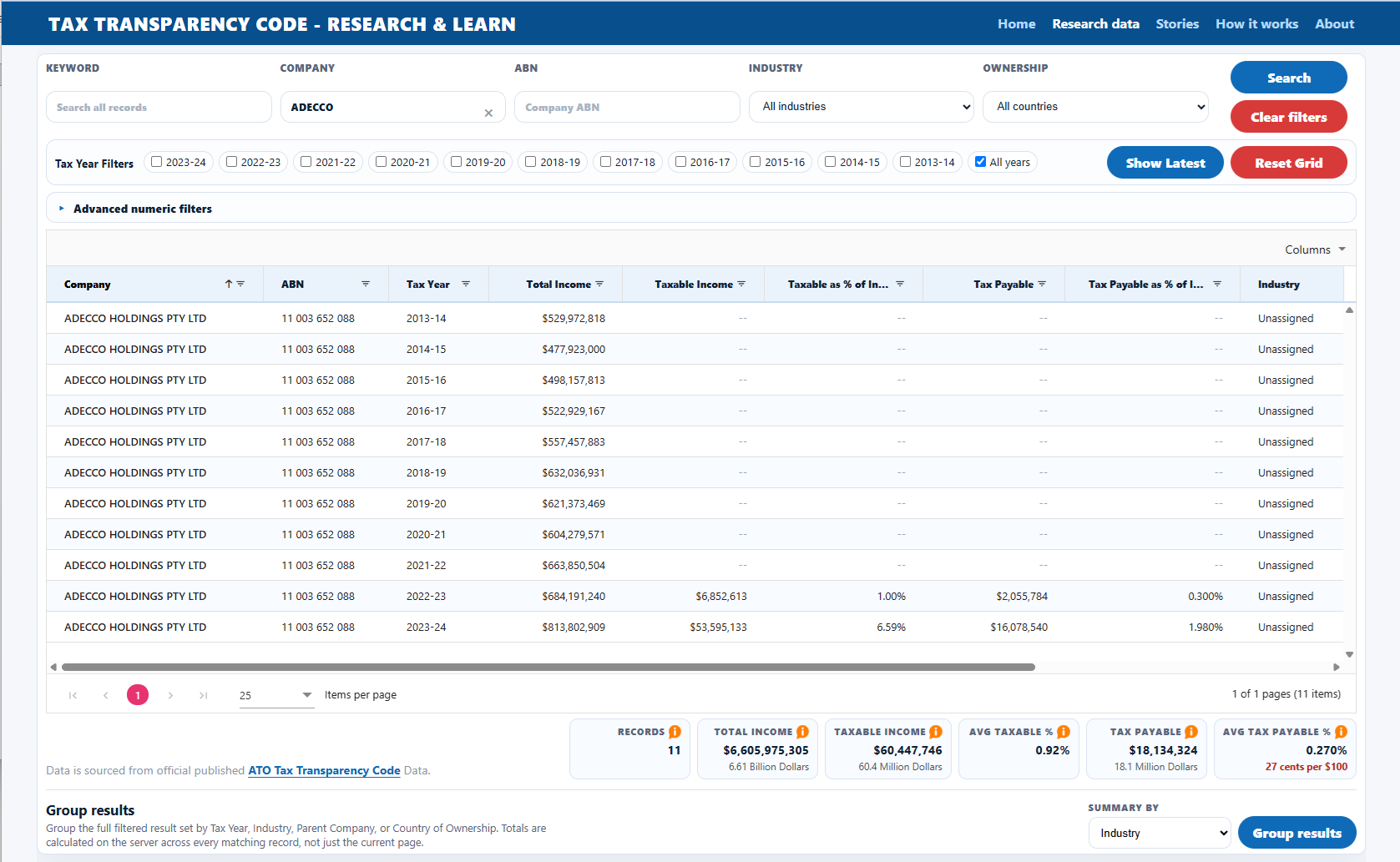 The dataExplore Adecco’s full record — and 4,000+ companiesOpen Adecco Holdings’ complete record in the live research grid and research it yourself — along with the historical figures for more than 4,000 companies.View the live data
Source: Tax Transparency Code research grid, based on ATO-published corporate tax transparency data, accessed 28 June 2026.